New Wage Code 2025–26: How the 50% Wage Rule Reprices Your Statutory Liabilities
26 March 2026
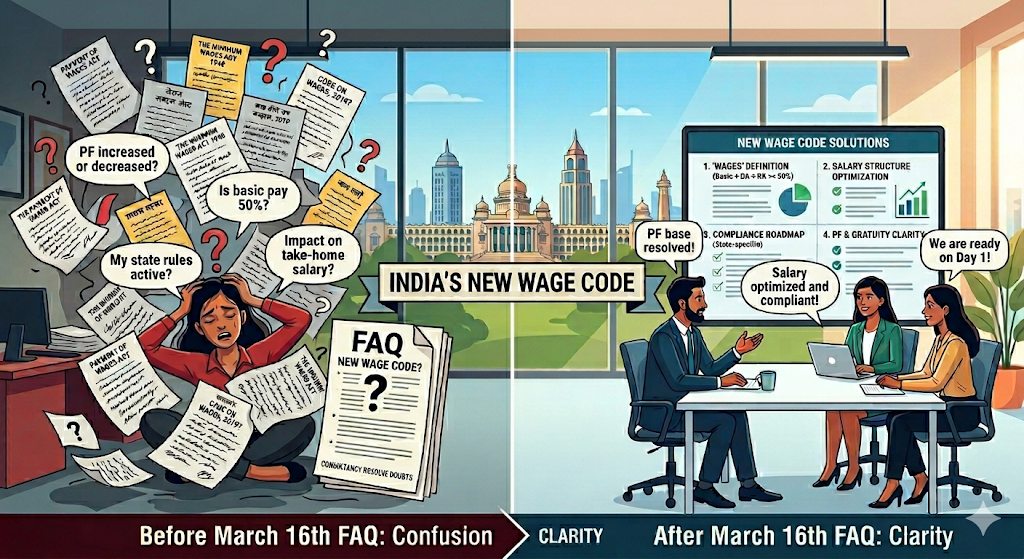
The implementation of the New Labour Codes on November 21, 2025 introduced a unified definition of wages. The Additional FAQs released by the Ministry of Labour on March 16, 2026 then clarified how additional components such as overtime, shift allowances, and in-kind benefits impact your statutory base.
For HR and Finance teams, the takeaway is simple: once allowances cross 50% of total remuneration, statutory wages rise -and so does your cost of compliance.
The Periodicity Filter: Annual vs Monthly
The new clarification draws a clear line based on payment frequency.
Monthly / Quarterly / Non-Annual: Overtime, shift allowances, and monthly incentives are treated as excluded components. If these plus HRA and other allowances cross 50% of remuneration, the excess is added back to the wage base.
Annual Periodicity: Genuine annual payouts (for example annual performance bonus) are not treated as remuneration for the 50% test and can keep wage base more stable.
Scenario A: Fixed Monthly Remuneration (The Pull-Up Effect)
Monthly CTC: Rs 50,000
Current structure: Basic Rs 20,000 + allowances Rs 30,000
50% rule target: Rs 25,000
Result: wage base is forced up from Rs 20,000 to Rs 25,000
Impact: gratuity for 6 years can rise from ~Rs 69,230 to ~Rs 86,538 (about 25% increase)
Scenario B: High Variable Payouts (The Overtime Shift)
Fixed CTC: Rs 50,000
Additional monthly payouts: Overtime Rs 2,200 + Awards Rs 5,000
Total remuneration in that month: Rs 57,200
50% threshold: Rs 28,600
Impact: statutory wage base for that month jumps sharply (~43% vs fixed baseline)
Scenario C: The ESI Coverage Trap (Silent Risk)
Monthly CTC: Rs 40,000
Old status: employee exempt because gross exceeded Rs 21,000
New test base: revised wages = 50% of CTC
Math: 50% of Rs 40,000 = Rs 20,000
Impact: employee may now fall under ESI coverage, reducing take-home and increasing employer overhead
Scenario D: In-Kind Complexity (Floor vs Ceiling)
In-kind benefits (meal coupons, vouchers, etc.) work through a double-gate: a 15% floor that is deemed wages, and a 50% ceiling test where excess exclusions can push wages further up.
Floor (15% Rule): In-kind value up to 15% of wages is deemed to be wages
Ceiling (50% Rule): Excess in-kind value acts as an exclusion and can trigger add-back if total exclusions breach 50%
Result: small in-kind values get absorbed quickly, while larger values can inflate statutory wage base further
| Component | In-Kind = Rs 2,500 | In-Kind = Rs 5,250 |
|---|---|---|
| Initial Basic | Rs 25,000 | Rs 25,000 |
| In-Kind Amount | Rs 2,500 | Rs 5,250 |
| Deemed as Wages | Rs 2,500 (full) | Rs 3,750 (capped at 15%) |
| Remaining Exclusion | Rs 0 | Rs 1,500 (adds to 50% test) |
| Final Statutory Wage | Rs 27,500 | Rs 28,750 |
Conclusion: Time to Re-Audit Your Salary Structure
The March 16 FAQs reinforce a wage-heavy compliance approach. Structuring pay with high allowances to reduce statutory contributions is no longer reliable for most organizations.
Re-simulate payroll with variable payout and ESI re-entry scenarios
Review periodicity definitions and ensure annual components are explicitly documented
Update gratuity actuarial assumptions to avoid year-end balance sheet surprises
Conclusion
If you are revisiting compensation philosophy or planning year-end provisioning, model alternate structures now. Early redesign prevents hidden liability buildup and improves board-level predictability.
Need help with this?
If you are preparing for year-end provisioning under the New Wage Code, Resolve can help you model alternate salary structures, quantify statutory impact, and implement a compliant board-ready framework.